When you collect feedback, you are not just gathering quotes. You are shaping how future customers see your product.
The challenge is that B2B buyers and B2C buyers do not think the same way. They look for different things, trust different signals, and respond to different kinds of customer stories.
If you want high-performing testimonial collection, you need to understand these differences clearly.
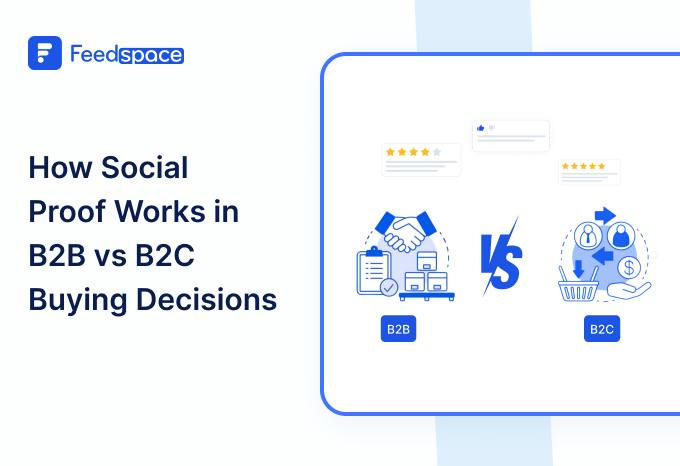
Read more: How Social Proof Works in B2B vs B2C Buying Decisions
How B2B Buyers Think vs How B2C Buyers Think
A B2C buyer acts fast. They make decisions based on emotion, comfort, relatability, and quick wins. They want to feel something. They want to see someone like them enjoying the product.
A B2B buyer thinks more slowly. They look at risk, process, results, timelines, accountability, and ROI. They need to justify their purchase to a manager or a team. They look for logic before emotion.
B2C buyers ask:
- “Will this make my life easier or better today
B2B buyers ask:
- “Will this solve a real problem, reduce cost, or improve workflow?”
That one difference changes your entire review strategy.
What Each Audience Wants in Testimonials
B2C audiences want quick and relatable customer stories. Short lines. Simple benefits. Emotion. Real people. Social vibes.
They love things like:
- “This saved me so much time.”
- “Feels great to use.”
- “I didn’t think it would help this much.”
They trust visuals more than long explanations. They prefer faces over numbers.
B2B audiences want proof. They want structured B2B case studies that show the problem, solution, and outcome.
They respond to things like:
- “Improved our onboarding time by 40 percent.”
- “Reduced weekly workload by ten hours.”
- “Helped us scale support across teams.”
They trust clarity more than emotion. They prefer numbers over vibes.
Format Differences
The format you use depends completely on the buyer mindset.
B2C formats:
- Short text quotes
- One line reactions
- Photos
- Short casual videos
- Screenshots from the customer
- User generated clips
These work because B2C decisions rely on feeling and ease.
B2B formats:
- Deep dive video testimonials
- Written case studies
- Screenshots of dashboards or results
- Workflow examples
- Team interviews
- Before and after metrics
These work because B2B decisions rely on logic and risk reduction.
Your testimonial collection should offer both, but each style must speak directly to the mindset of the buyer.
Collection Strategies That Work for Each Segment
For B2C feedback. The best approach is to ask right when they experience a moment of happiness.
Moments like:
- First use
- First result
- A message saying they loved something
- A social tag
- A positive DM
Keep the ask simple: “Mind sending a quick clip or line about your experience?” This creates authentic B2C feedback that feels natural.
For B2B clients. Timing matters even more. The best time to collect testimonials is right after:
- A successful project delivery
- A milestone
- A resolved challenge
- A performance improvement
- A target being met
Ask with clarity: “Can we document this result as a short case story so your team can inspire others?”
This creates high trust client trust content that shows depth, not just praise.
How Feedspace Supports Both
B2C needs quick capturing.
B2B needs structured capturing.
Feedspace does both by giving you:
- Clean workflows for casual B2C feedback
- Templates for collecting structured B2B case stories
- Easy video recording for instant clips
- Tools for teams to submit long form stories
- A central dashboard where everything stays organised
- Automatic reminders to remove manual chasing
You can gather Feedspace video testimonials, text testimonials, or full case studies all in one place.
This means you never have to choose between emotion and logic. You get both.
Collect testimonials for free with Feedspace
Try for Free
Conclusion
Your testimonial collection is only strong when it speaks to the mindset of the person reading it. B2C buyers want to feel seen. B2B buyers want to feel safe. Both want honesty. Both want proof. When you match the right story to the right audience, you make buying easier.
If you want the process to run smoothly without chasing anyone, use Feedspace to collect, organise, and publish customer stories across both segments. Sign up for Feedspace today!