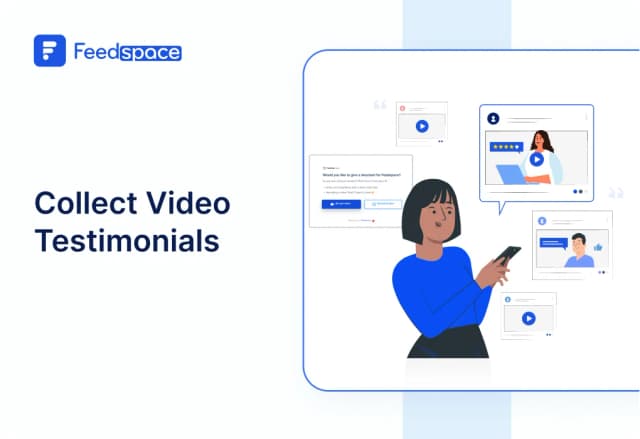
A video testimonial is a short video where a real customer shares their experience with a product or service. It usually covers the problem they had, how the product helped, and the result they got. Businesses use video testimonials on websites, landing pages, and ads to build trust and increase sales.
You see a product online and wonder if it really works. A written review helps a little. A real customer on camera helps a lot more.
That is what a video testimonial does. It shows a real person, in their own words, explaining how your product helped them. Wyzowl found that 79% of people say a testimonial video convinced them to buy. BrightLocal reports that 88% of consumers trust them as much as advice from a friend.
Video testimonials are one of the strongest forms of social proof you can use. They are also easier to collect than most people think.
Feedspace allows you to capture fresh content, import it from various sources, manage your testimonial library, and showcase it on your website with ease.
This guide covers what a video testimonial is, the types, the benefits, and real examples. You will also see where to place them on your site.
What is a Video Testimonial?
A video testimonial is a short video where a real customer shares their honest experience with your product, service, or brand.
Most run 30 to 90 seconds. The customer speaks in their own words, not from a script. That is what makes them believable.
So why bother with them? Four reasons stand out.
- Show Off Real-Life Success: Between an offline and online environment, video testimonials help bridge the gap, and “seeing is believing”, as mentioned earlier.
- Hook In The Audience: From start to finish, they will keep a majority of users locked in, which storytelling and visual proof combined do.
- Highlight Niche Issues: How your brand solved them, and specific problems most video testimonials single out. With similar concerns, this can resonate with a viewer.
- Repurpose Content: For multiple channels, emails, social media, YouTube, website landing pages, presentations, and even pitch decks, the user content generated through video testimonials can be repurposed.
Anatomy of a Video Testimonial
The 3 Parts of a Video Testimonial
Every strong video testimonial follows the same simple shape.
- The problem. The customer explains what was going wrong before they found you.
- The solution. They share how your product fixed it.
- The result. They name the outcome, ideally with a number.
That is the full story arc. When a customer covers these three parts, the video works.
What else to include:
- The customer’s name, job title, and company/
- A clear shot of their face.
- One specific detail or number, like hours saved or sales gained.
How long should it be? Keep it between 30 and 90 seconds. Short videos hold attention and are easier to share.
Types of Testimonials Compared
Video is not your only option. Here is how the main types of testimonials stack up.
| Type | Trust level | Effort to collect | Best used for |
| Video testimonial | Highest | Medium | Landing pages, ads, sales calls |
| Audio testimonial | Medium | Low | Podcasts, camera-shy customers |
| Text review | Medium | Lowest | Volume and social proof counts |
| Case study | High | Highest | B2B deals and long sales cycles |
| Social media clip | High | Low | Social feeds and quick proof |
Use a mix. Video should be your first choice when trust matters most. You can also collect Google reviews to build volume alongside your videos
Video Testimonials vs Other Testimonials
Audio Testimonials
Audio testimonials are voice recordings without video. They are less common online.
These testimonials are left in the form of voice recordings and snippets. On the internet, we see very few audio testimonials. But in cases where audiences do not want to show themselves on video for any reason or might be camera-shy, they’re a good option.
But as video testimonials, they still don’t have the same impact. If the person giving you a testimonial is not comfortable being on camera, only consider this.
Text Reviews
Text reviews are the most common form of testimonial. They are popular because they are quick to write and easy to edit.
The problem is trust. They are also easy to fake or generate with AI. They do not build the same level of trust as video.
As opposed to text or audio-based ones, this is why it is best to build social proof with video testimonials. Don’t get us wrong. You have to feature a healthy mix of.
But across platforms, video testimonials should be your primary option due to advantages like higher authenticity, memorability, versatility, and higher engagement statistics.
Benefits of Video Testimonials
1. Builds Trust Through Authenticity
Trust builds faster when a real person talks in the video and vouches for the product or brand than when someone just reads text reviews.
2. Increases Engagement and Retention
A video grabs attention and retains it better because people often pause to watch videos while browsing the internet or scrolling social media.
3. Boosts Conversions
A/B test data show video testimonials can lift conversion rates by around 34%. Placing one near your buy button helps most.
4. Improves Recall
People keep about 95% of a message from video, but only 10% from text. Your story sticks.
5. Works Across Channels
Record once, use everywhere. Website, ads, emails, sales decks, and social posts.
6. Hard to Fake
A face, a voice, and a real name are difficult to invent. That is why buyers believe them.
Why Are Video Testimonials Effective?
To understand why and what makes video testimonials effective, let us understand a bit more in depth.
1. Facial Expressions:
They tend to use facial expressions when a person is on video, endorsing it or talking passionately about something. This puts viewers at ease; they convey their honesty candidly.
2. Tone of Voice:
When they are talking about something, tone refers to the intonation used by people. When someone has memorised what they want to say, is faking, or is reading something scripted, you can easily tell.
3. Visuals:
On consumers, an added impact high quality video testimonials with visuals and effects to support the words.
4. Credibility:
Video testimonials show a name, job title, and company. When a viewer recognises the person or the brand, the endorsement carries more weight.
Since they started recording this data, that’s apparently the highest result they’ve gotten, and 93% of marketers say video marketing has given them a good ROI, according to a study by Wyzowl. To enhance engagement and reach, utilise video marketing software to achieve similar success.
Multiple uses of video testimonials have been remembered. They can even be used as accompaniments to case studies, PR articles, and in communication like emails. On social media or embedded on landing pages, they aren’t just assets to show off. To ensure that it’s powerful and has the right messaging, the only aspect you have to get right is. When you ask for a testimonial from your clients and customers, let us check out how you can ensure this.
Best Video Testimonial Examples
Not all testimonial videos look the same. Businesses use different formats depending on their audience, product, and marketing goals. Here are some common video testimonial examples you can use.
1. Customer Story Testimonial
This is one of the most popular formats. In this style, customers explain the problem they had, how they discovered the product, and what results they achieved after using it.
It feels natural and relatable because viewers can see a real customer sharing their experience. These testimonials work well on landing pages and product pages where potential customers want proof before making a decision.
2. Interview-Style Testimonial
In this format, the customer answers a few guided questions. Someone from the company (or the interviewer) asks questions like:
- What challenge were you facing before?
- Why did you choose this product?
- What results have you seen?
The conversation format makes the testimonial feel authentic and less scripted.
3. Before-and-After Testimonial
This format focuses on the transformation a customer experienced.
The customer explains their situation before using the product and then highlights the improvement they saw afterward. These videos are especially effective for SaaS tools, marketing services, and products that deliver measurable results.
4. Short Social Proof Clips
Some testimonials are short and simple. Customers record quick 15–30-second videos sharing a positive experience.
These clips are perfect for social media, ads, and website sections where you want to quickly build trust.
To know about actual people, brands, and businesses that have used Feedspace and gotten results, check out these case studies, but don’t just take our word for it:
Speak English With Tiffani: With her 3M+ subscribers and students worldwide an English tutor who uses Feedspace to stay connected.
Yoganovisen: From their students, a yoga school that used Feedspace to collect testimonials and gain a larger audience.
House Of Huegah: From Gujarat, India, a local business that uses Feedspace to collect reviews from its customers. Right on the receipts, they even place QR codes leading to their testimonial collection forms.
How to Collect Video Testimonials Easily
Many businesses struggle to collect testimonials because the process feels complicated for customers. If recording and sending videos requires too many steps, most people simply won’t do it.
The easiest way to collect video testimonials is by giving customers a simple recording link.
Instead of asking them to record a video, upload it somewhere, and send it to you, you can provide a single link where they can record the testimonial directly from their phone or computer.
With tools like Feedspace, businesses can:
- Send customers a testimonial collection link
- Allow customers to record a video instantly
- Automatically collect and organize testimonials
- Use them on websites, landing pages, and marketing campaigns
This removes friction from the process and significantly increases the number of testimonials you receive.
Where to Put Video Testimonials on Your Website
Placement changes results. Put videos where doubt shows up.
- Homepage. One strong video near the top builds instant trust.
- Product pages. Match the video to the product being viewed.
- Pricing page. Answers the “is this worth it” question.
- Checkout or signup. A short clip near the button reduces drop-off.
- A Wall of Love page. One page that gathers all your best videos and reviews.
A Wall of Love is the simplest way to show video testimonials on websites without touching your design. The Feedspace Wall of Love matches your site theme and embeds in a few clicks.
How Feedspace.io Simplifies Video Testimonial Collection
1. Quick and Easy Setup:
With no special instructions or learning curves needed, you’re ready to use it from the start. Start rolling in video testimonials as you sign up, create a form, and send it to your audience.
2. Multiple Sources:
From sites across the internet or by collecting new ones using forms, the tool allows you to import existing video testimonials.
3. Easy-To-Use Interface:
To be user-friendly with a clean layout, the interface of the tool is designed. Accessible to multiple team members and contributors, this makes it.
4. Ready-To-Use Marketing Assets:
Without disrupting anything, Feedspace’s Wall of Love feature is designed to allow its users to customise the aesthetics of their testimonial showcase to match their existing website’s theme.
5. Centralized Management:
Within your selected workspace, all collected video testimonials are stored. To manage, monitor, and even choose what you want to share with whom, this gives you complete control.
How to Get Started with Feedspace.io
Getting started with Feedspace is super simple. Just follow these steps:
- Sign up. Create an account with any email or your Google account on the Feedspace sign-up page.
- Onboarding. Once you sign in, you get a new workspace and dashboard, plus a quick walkthrough.
- Build collection forms. Start creating a form to collect testimonials with your own prompts and instructions.
- Start collecting. Share your form with customers. You can also import reviews you already have from other platforms.
- Manage centrally. Access every testimonial from your dashboard, anytime.
That’s it. All of it is how simple that is. Claim your free Feedspace account today. Head on over to our sign-up page. Or book a demo with our product expert here if you’d like a personalised walkthrough or have any other questions.
Conclusion
A video testimonial is simple proof that your product works. One real customer, one clear story, in under 90 seconds.
You do not need a film crew or a big budget. Pick a happy customer, send them a recording link, and put the video where buyers will see it.
Video testimonials build trust faster than any sales page you can write. Your customers have the stories. You just need an easy way to capture them.
Try Feedspace free and collect your first video testimonial this week.
FAQs
1. What is a video testimonial?
A video testimonial is a recorded video where a customer shares their experience with a product or service. It usually includes the problem they faced, how the product helped them, and the results they achieved.
2. How to ask for video testimonials?
The easiest way to ask for a video testimonial is to reach out to happy customers and keep the request simple. Ask them to share a short video about their experience and guide them with a few questions like what problem they had, how the product helped, and what results they saw.
3. How to record a video testimonial?
A video testimonial can be recorded using a smartphone, webcam, or laptop camera. The speaker should record in a quiet place with good lighting and keep the video short, usually between 30 and 90 seconds. The best testimonials feel natural and focus on the customer’s real experience.
4. Which is the Best Video Testimonial Software?
The best video testimonial software is one that allows customers to easily record and submit testimonials without complicated steps. Tools like Feedspace help businesses collect video testimonials through a simple recording link, making the process quick and convenient for customers.
5. Where can you use video testimonials?
Video testimonials can be used across different marketing channels to build trust and influence buying decisions. Businesses commonly use them on landing pages, product pages, websites, social media, advertisements, and email campaigns. Showing real customer experiences in these places helps potential customers understand the value of the product and feel more confident about choosing it.